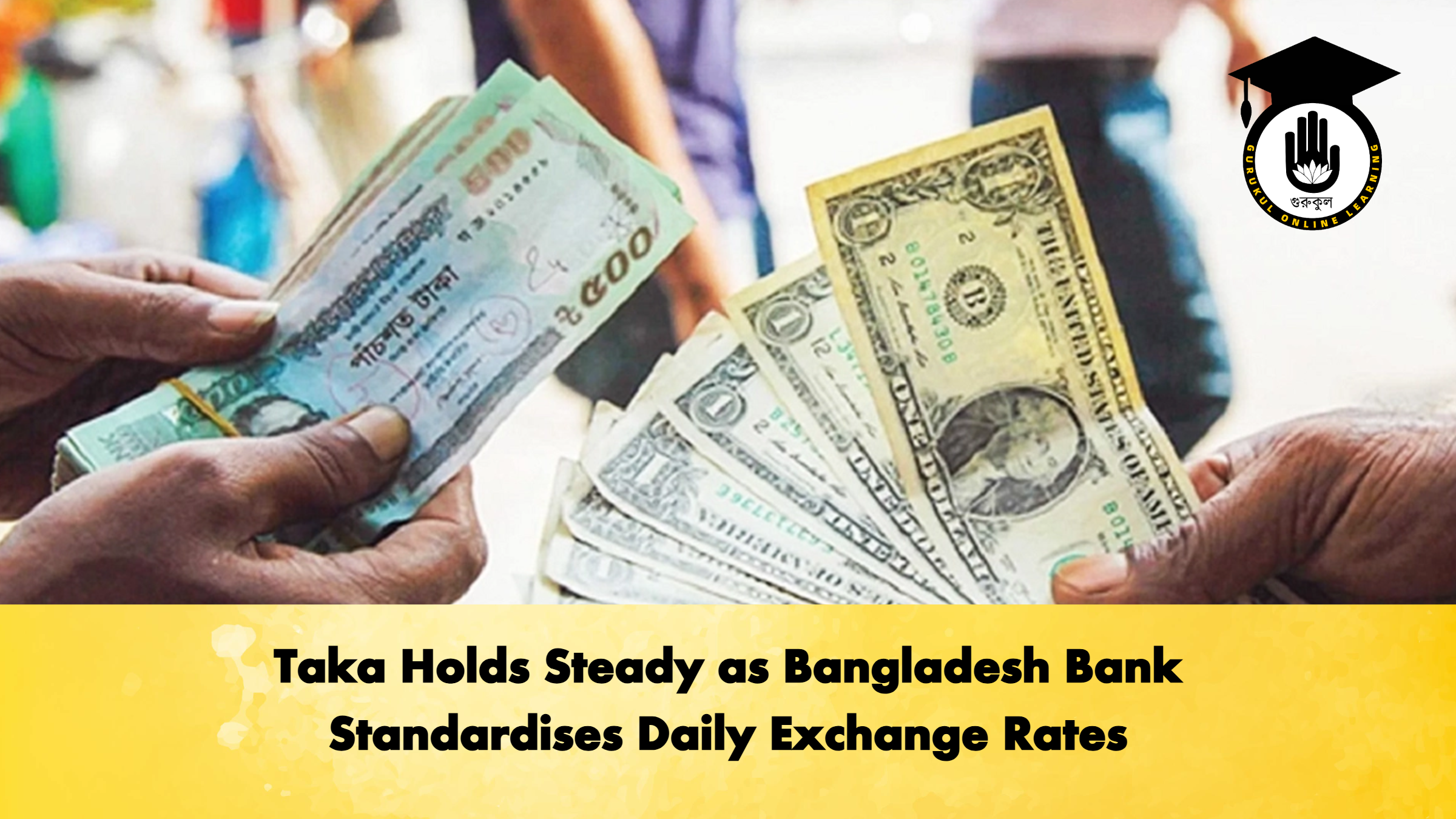
The Bangladeshi Taka maintained relative stability across major foreign currencies today, according to official benchmark rates released by Bangladesh Bank on 19 September 2026.
At the core of the update, the US Dollar is listed at a buying rate of 122.90 Taka and a selling rate of 123.00 Taka. Because the greenback remains the primary currency for international trade, import clearings, and remittances, its position dictates wider consumer prices and commercial shipping costs throughout the national economy.
European currencies continue to show a distinct buying and selling margin. The British Pound sterling stands at 164.45 Taka buying and 164.62 Taka selling. The Euro trades at 140.89 Taka for buying and 141.04 Taka for selling. These rates directly influence non-resident transfers, cross-border business arrangements, and personal expenses for individuals travelling to the United Kingdom and continental Europe for higher education or medical care.
Trade across the Asia-Pacific region reveals similarly stable dynamics. The Indian Rupee, heavily used for cross-border commerce, medical tourism, and educational visits, stands at an even 1.28 Taka for both buying and selling. The Chinese Yuan trades between 18.31 Taka buying and 18.32 Taka selling, while the Japanese Yen rests at 0.79 Taka for both transactions. Elsewhere in the region, the Australian Dollar trades at 87.09 Taka buying and 87.21 Taka selling, alongside the Singapore Dollar at 96.13 Taka buying and 96.24 Taka selling.
A standard margin generally exists between buying and selling quotes across the banking sector. The buying rate applies when an individual or business sells foreign currency to a financial institution, whereas the selling rate applies when purchasing foreign tenders. While most major currencies display a slight administrative spread, both the Indian Rupee and Japanese Yen exhibit matching buying and selling benchmarks in today’s official central bank publication.
Central bank figures serve as a baseline for the broader financial sector. Actual transactional rates offered by commercial banks, authorised money changers, and financial establishments may vary slightly based on transaction types, settlement timing, and individual institutional margins. Businesses and private travelers are advised to verify real-time operational rates with their respective financial institutions prior to carrying out foreign currency transactions.