Banks and non-bank financial institutions are largely controlled by their sponsors and directors, who make key decisions on lending, fund management and overall financial operations. Ordinary shareholders, particularly those investing through the stock market, have little or no direct influence over such decisions. Yet when institutions become distressed because of irregularities, alleged embezzlement, excessive non-performing loans or poor management, it is often the ordinary investors who end up bearing a substantial part of the financial loss.
The immediate impact is usually felt through falling share prices. As an institution’s financial condition deteriorates, its market value can decline sharply, eroding investors’ capital. When trading is subsequently suspended, shareholders lose the ability to sell their holdings in the market. If the institution is eventually declared non-functional or placed into liquidation, recovering any remaining value from the investment becomes even more uncertain.
This has created a difficult question for Bangladesh’s financial and capital markets: should investors who had no role in the decisions that caused an institution’s collapse also have to bear the consequences?
Table of Contents
ToggleFive banks set a difficult precedent
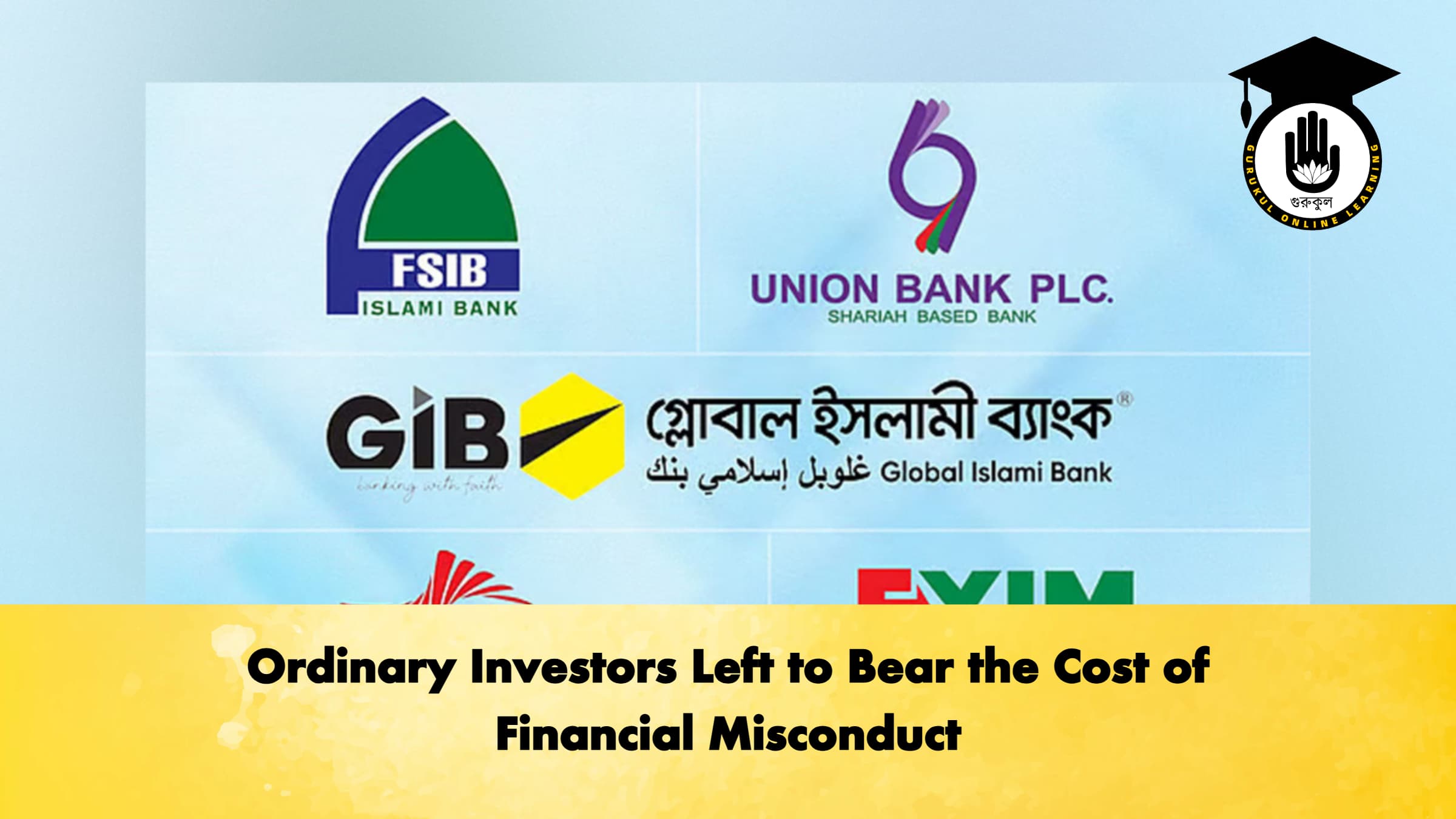
The issue came into sharp focus following the consolidation of five banks: First Security Islami Bank, Social Islami Bank, EXIM Bank, Global Islami Bank and Union Bank.
As part of the consolidation process, trading in their shares was suspended around a year ago. Their share values were subsequently declared zero under the Bank Resolution Ordinance, 2025, on the grounds that their liabilities exceeded their assets. As a result, there was reportedly no residual value available for shareholders.
The decision came after Bangladesh Bank took control of the banks following the dissolution of their boards in November last year. Trading in their shares was then halted on both the Dhaka Stock Exchange and the Chittagong Stock Exchange.
The shareholder base of these institutions included sponsors and directors as well as thousands of ordinary investors who had acquired shares through the stock market. While the latter had no involvement in the banks’ lending decisions or internal management, they nevertheless faced the prospect of losing their investments.
Former Bangladesh Bank governor Ahsan H Mansur had said the equity value of the five banks’ shareholders had turned negative, meaning their shares would be treated as having no value. The banks’ net asset value per share was reportedly negative by between Tk350 and Tk420. There was also a plan not to provide shares in the newly formed Sammilito Islami Bank to the existing shareholders.
The decision prompted questions over whether ordinary investors, who were not directly involved in the alleged irregularities, should receive any compensation.
The issue was subsequently discussed at government level. Former interim government Finance Adviser Dr Salehuddin Ahmed said consideration was being given to returning part of ordinary investors’ investments. He also said the Finance Ministry would determine how such payments could be made after discussions with relevant stakeholders.
Nearly a year later, however, the matter remains unresolved. Although compensation for affected shareholders has been discussed at different levels, there is still no clear indication of when or how such relief might be implemented.
Three listed finance companies face similar uncertainty
The same concern has now emerged among shareholders of three listed non-bank financial institutions.
On 9 August, Bangladesh Bank declared four non-bank financial institutions non-functional: Aviva Finance, Fareast Finance and Investment, FAS Finance and Investment, and International Leasing and Financial Services. Aviva Finance is not listed on the stock market, while the other three are listed entities.
Bangladesh Bank dissolved the boards of all four institutions and appointed its own officials as administrators. The decision followed concerns over their prolonged financial distress, limited prospects of recovery and longstanding irregularities.
From 10 August, trading in the shares of Fareast Finance, FAS Finance and International Leasing was suspended indefinitely by the Dhaka Stock Exchange and the Chittagong Stock Exchange.
For ordinary shareholders, the suspension has effectively frozen their investments. Their immediate concern is whether any portion of their capital will eventually be recovered after the institutions’ assets and liabilities are settled.
Problems built up over years
Industry observers say the financial difficulties of Fareast Finance, FAS Finance and International Leasing are not recent developments. The institutions had struggled for years to repay depositors, while mounting non-performing loans and weak management further damaged their financial positions.
Yet there were periods when share prices of some of these companies rose sharply in the stock market. Market rumours and speculative activity sometimes pushed prices higher, even though investors had little or no meaningful return over extended periods.
The wider crisis in the non-bank financial sector has been associated with longstanding irregularities, rising defaulted loans and weaknesses in corporate governance and management.
In 2025, the non-performing loan ratios of nine non-bank financial institutions facing liquidation initiatives from Bangladesh Bank ranged between 75 per cent and 98 per cent. Fareast Finance, FAS Finance and International Leasing were among those institutions.
There have also been allegations in various reports that PK Halder was involved in the misappropriation of at least Tk3,500 crore from several financial institutions, including International Leasing and FAS Finance.
Against this backdrop, ordinary shareholders are asking why they should bear losses arising from lending, fund transfers and board-level decisions over which they had no control.
Depositors have priority, but shareholders remain uncertain
The question of returning money to depositors has received greater attention in the resolution of troubled non-bank financial institutions. More than 12,000 depositors of six distressed institutions have reportedly been seeking repayment for a prolonged period, with individual depositors accounting for part of the deposits involved.
Bangladesh Bank has said that depositors’ funds are expected to be returned on a priority basis, either in two phases or through a special scheme.
The position of ordinary shareholders is different. Under the normal liquidation process, an institution’s assets are first realised and used to meet its liabilities. Shareholders can receive money only if funds remain after those obligations have been settled.
Bangladesh Bank spokesman Arif Hossain Khan said sponsors and directors would not receive anything after liquidation. Whether ordinary investors would receive any money, however, would be clarified under the scheme to be announced.
That distinction has intensified concerns among small investors. If public intervention is considered necessary to protect depositors, they want to know whether some form of protection will also be considered for ordinary shareholders who were not responsible for the institutions’ financial decisions.
A Bangladesh Securities and Exchange Commission official said the commission’s options would be limited if the institutions were directly liquidated without any provision for ordinary investors.
Regulators face a difficult balancing act
The issue is complicated by the different legal positions of depositors and shareholders.
Depositors are creditors of an institution, while shareholders effectively bear the residual risk of ownership. In a conventional liquidation, shareholders rank behind creditors when assets are distributed. This means shareholders may receive nothing if an institution’s liabilities consume the entire value of its assets.
For the three troubled listed financial institutions, there is concern that little or nothing may remain after assets are sold and liabilities are settled.
The Bangladesh Securities and Exchange Commission has therefore urged that ordinary investors be considered when the liquidation or resolution framework is prepared.
Commission Executive Director and spokesman Md Abul Kalam said the commission had already written to Bangladesh Bank requesting that the interests of ordinary investors be taken into account while preparing schemes for the financial institutions’ resolution. The letter also proposed that if public funds were allocated to any stakeholder when a listed financial institution was closed, ordinary investors should also be considered for an allocation.
Compensation remains contentious
Former Bangladesh Securities and Exchange Commission chairman Faruk Ahmed Siddiqi takes a more cautious position on compensation.
He has argued that investors should examine a company’s financial condition and prospects before committing their money. Investors, he said, should avoid companies that do not appear suitable for investment.
He also pointed out that even depositors who placed large sums of money with weak financial institutions are struggling to recover their funds. Against that backdrop, returning money to ordinary shareholders would be an especially difficult proposition.
If the government decides to provide assistance to ordinary shareholders, he believes it would have to be a policy decision. At the same time, he questioned whether taxpayers’ money should be used to compensate losses suffered by a relatively small section of the population.
The debate therefore extends beyond the question of whether investors should receive compensation. It also concerns who should ultimately bear the cost and under what legal or policy framework.
Calls for a specific investor-protection framework
Dhaka University accounting professor Md Al-Amin believes the issue cannot be addressed solely through existing legal provisions.
In his view, ordinary investors should not be treated as personally responsible when banks or financial institutions collapse because of management failures or irregularities. Regulatory authorities, he argues, should work together to develop a practical mechanism for protecting investors rather than limiting their response to exchanges of letters.
He also pointed to the absence of a specific policy framework for compensating or protecting ordinary shareholders in such circumstances.
Under existing principles, shareholders may receive nothing if an institution’s assets are insufficient to cover its liabilities. But the professor argues that applying the same approach mechanically to institutions whose financial distress resulted from alleged misappropriation, irregularities or serious management failures may leave ordinary investors bearing consequences they had no role in creating.
The cases involving the five banks and the three listed non-bank financial institutions have consequently exposed a wider weakness in Bangladesh’s financial market: the lack of a clear mechanism for distinguishing between those responsible for institutional failures and ordinary investors who simply held shares.
For regulators, the challenge is to protect depositors without creating an open-ended burden on taxpayers, while also ensuring that ordinary shareholders are not left without any consideration when institutions collapse because of failures beyond their control. How that balance is ultimately struck could have significant implications for confidence in both the banking sector and Bangladesh’s capital market.