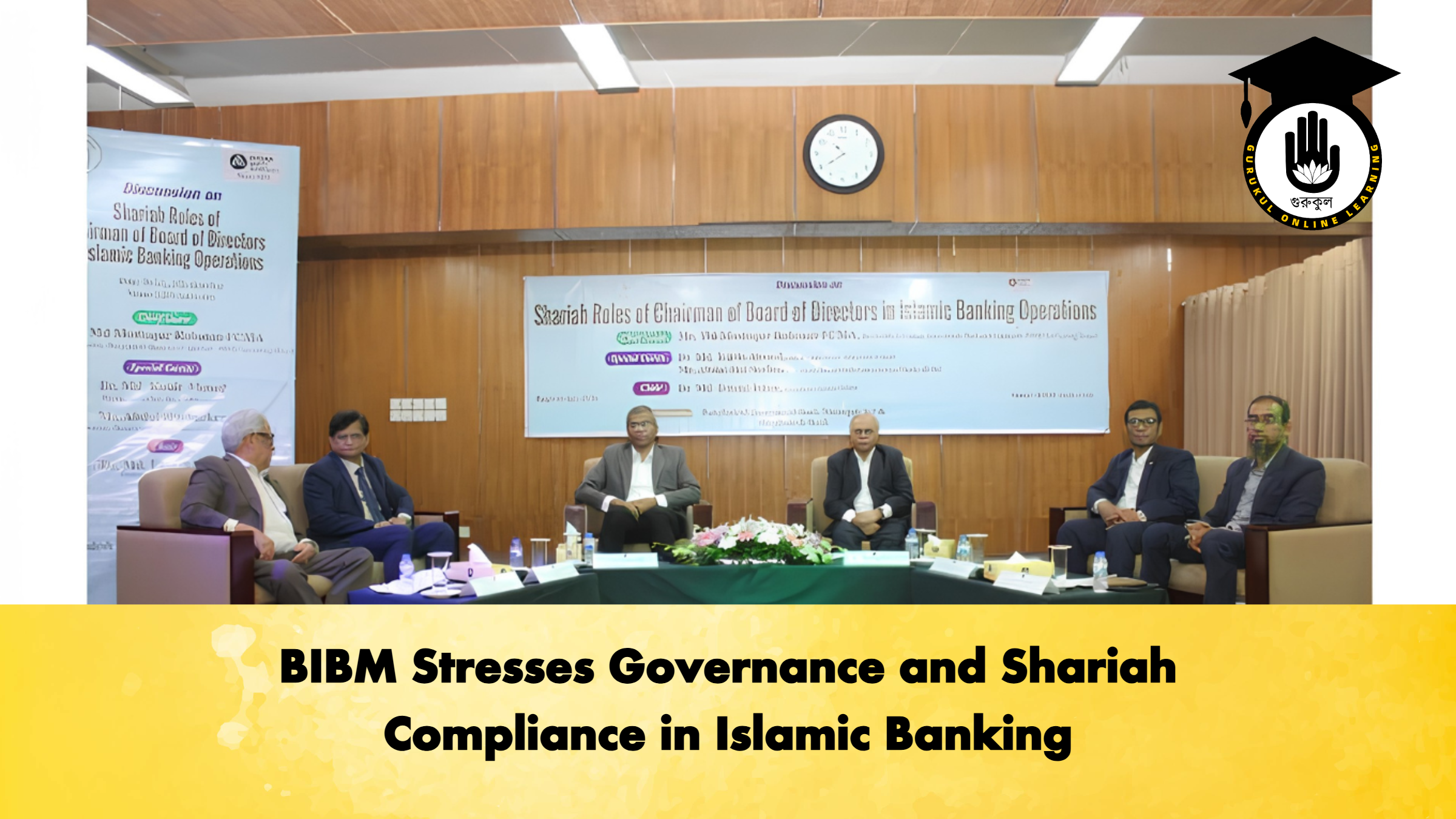
The Bangladesh Institute of Bank Management (BIBM) and the Islamic Banks Regulation and Policy Department of Bangladesh Bank jointly organised a high-level workshop in Dhaka to address critical challenges in the country’s rapidly expanding Islamic banking sector. The event, held at the BIBM campus, focused on enhancing governance standards and ensuring rigorous Shariah compliance to protect public trust and guarantee long-term financial stability.
Titled “Discussion on Shariah Roles of Chairman of Board of Directors in Islamic Banking Operations”, the programme brought together central bankers, commercial bank directors, academics, and industry experts. The central theme resonated around accountability, regulatory reforms, and the shifting responsibilities of leadership within faith-based financial institutions.
Md Mostaqur Rahman, FCMA, Governor of Bangladesh Bank and Chairman of the BIBM Governing Board, attended the workshop as the chief guest. Addressing the audience, the Governor highlighted the deep-rooted public preference for Shariah-compliant financial products in Bangladesh. Given this widespread demand, he stressed that Shariah Councils must transition into more proactive and effective bodies capable of safeguarding public confidence.
The Governor reaffirmed that the central bank is prioritising the overhaul of corporate governance standards. A primary objective of these ongoing regulatory interventions is to insulate the banking sector from political interference and restore institutional integrity. Looking ahead to modernising the wider financial landscape, the Governor expressed optimism regarding the nationwide adoption of ‘Bangla QR’, which is expected to significantly accelerate digital financial transactions over the next year.
The workshop also featured critical perspectives on the structural composition of the country’s financial sector. Abdul Hai Sarker, Chairman of the Bangladesh Association of Banks (BAB), noted that Bangladesh currently operates with a higher number of banks relative to its neighbouring peers. He argued that a more rationalised and consolidated banking sector would significantly enhance regulatory supervision, managerial control, and overall operational efficiency.
Dr Kabir Ahmed, Deputy Governor of Bangladesh Bank, elaborated on the evolving regulatory landscape, noting that a newly designed oversight framework assigns far broader responsibilities to the Shariah compliance function. This updated mechanism is engineered to strengthen institutional accountability across all tiers of management. Dr Ahmed emphasised that because the popularity of Islamic banking shows no signs of slowing down, robust Shariah governance has become a non-negotiable prerequisite for sustainable development.
During his executive remarks, Dr Ezazul Islam, Director General of BIBM and chair of the session, pointed out that rapid commercial expansion must be balanced with strict adherence to Shariah principles. He maintained that transparency and compliance are the ultimate drivers of consumer trust and industry stability. To compete on a global stage, Dr Islam called for tighter operational coordination between boards of directors, executive management, and independent Shariah supervisory bodies. He reiterated BIBM’s long-standing commitment to assisting scheduled banks through targeted professional training, academic research, and strategic knowledge sharing.
Providing an update on legislative developments, Md Ashraful Alam, Executive Director of the Islamic Banks Regulation and Policy Department, revealed that the drafting of the highly anticipated Islamic Banking Act is nearing completion. The finalisation of this statutory framework is expected to deliver a transparent, efficient, and legally binding environment for all faith-based financial operations in the country.
The technical segment of the workshop included three detailed presentations delivered by members of the Shariah Advisory Board of Bangladesh Bank. These papers explored the practical application of Islamic legal maxims in contemporary finance, the operational implications of the Shariah Governance Framework, and the explicit fiduciary duties of board chairmen. The event concluded with an open floor discussion where delegates formulated policy recommendations aimed at refining oversight and driving structural reforms across the sector.