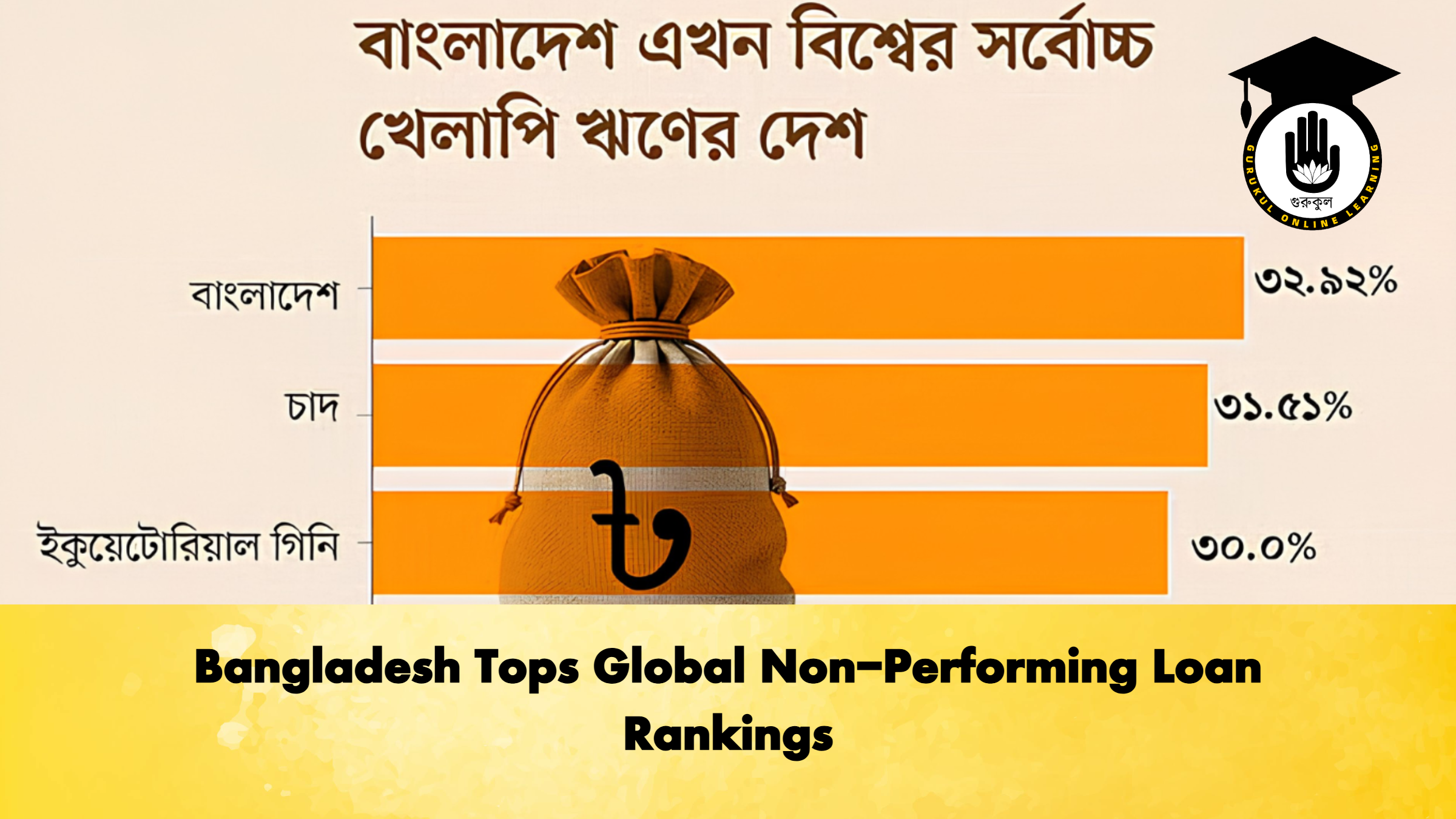
Bangladesh has emerged as the country with the highest proportion of non-performing loans in the world, with nearly one-third of all loans issued by its banking sector now classified as defaulted.
According to the latest available figures, the country’s non-performing loan ratio stood at around 32.8 per cent at the end of June 2026, placing Bangladesh ahead of Chad, Equatorial Guinea, Algeria and Ghana. The development marks a sharp deterioration in the health of the banking sector and reflects the gradual exposure of loans that had previously been kept from appearing as distressed assets.
At the end of June 2026, Bangladesh’s banking sector held non-performing loans worth Tk 606,555 crore. This represented approximately 32.78 per cent of total outstanding loans. Three months earlier, at the end of March, the figure had stood at Tk 588,704 crore, meaning defaulted loans increased by Tk 17,851 crore during the quarter.
The amount had previously reached a record Tk 644,515 crore in September 2025.
Industry observers say much of the problem did not emerge overnight. For years, a significant volume of troubled loans was kept classified as regular through repeated rescheduling, special regulatory concessions and changes in accounting treatment. Following political changes in the country, reviews of banks’ asset quality and audits by domestic and international institutions began exposing irregularities, fraudulent lending and loans issued under concealed or questionable identities.
As a result, many loans that had previously remained outside the official default figures are now being recognised as non-performing.
The situation is particularly severe in five banks that have undergone consolidation, where more than 80 per cent of total loans are reportedly classified as non-performing. Several other state-owned and private banks are also facing default ratios exceeding 50 per cent. Politically influenced lending, fictitious and anonymous borrowers, weak oversight, difficult business conditions and energy shortages have all contributed to the broader deterioration.
Among the countries with the highest reported levels of non-performing loans, Chad ranks second, with the latest available ratio standing at 31.51 per cent. However, this figure dates back to December 2023, and no newer data has been submitted to the relevant international financial database.
Equatorial Guinea ranks third, with non-performing loans accounting for around 30 per cent of the banking sector’s loan portfolio. The figure was higher, at 32.5 per cent, in 2023.
Algeria follows with a reported non-performing loan ratio of 20.05 per cent at the end of December 2025. Ghana ranks fifth, where the ratio stood at 18.11 per cent during the first quarter of 2026, down from 20.6 per cent in 2023.
Ukraine’s Sharp Improvement
Ukraine previously held the unwanted distinction of having one of the world’s highest non-performing loan ratios. In 2023, its ratio stood at 37.4 per cent and reportedly rose to nearly 39 per cent following the severe economic disruption caused by Russia’s invasion.
The country’s banking sector, however, has since followed a different trajectory.
From 2024 onwards, Ukraine increased loan recoveries, restructured distressed assets and expanded lending considered to be of comparatively better quality. These measures helped reduce the proportion of bad loans relative to total lending.
During the first six months of 2025, total loans in Ukraine’s banking sector increased by 133.7 billion hryvnia, or 10.3 per cent, while the non-performing loan ratio fell to 27 per cent.
A major change came in December 2025, when several state-owned banks, including the country’s largest lender, wrote off substantial volumes of old non-performing loans from their balance sheets. The sector-wide ratio fell from 23.91 per cent on 1 December 2025 to 13.92 per cent on 1 January 2026.
Such write-offs did not mean that borrowers were automatically relieved of their debts. The loans had already been fully provisioned, and removing them from the main balance sheets allowed banks to manage them separately while retaining the right to pursue recovery.
The downward trend continued. By 1 July 2026, Ukraine’s non-performing loan ratio had fallen further to 12.5 per cent, its lowest level in approximately 17 years. The country has therefore moved well outside the group of nations with the five highest non-performing loan ratios.
Bangladesh’s Opposite Direction
The contrast between Bangladesh and Ukraine has become increasingly clear.
Ukraine has reduced its ratio through loan recovery, restructuring, write-offs of fully provisioned legacy debts and the expansion of healthier lending. Bangladesh, by contrast, has seen a rapid rise in officially recognised non-performing loans.
In June 2024, Bangladesh’s banking sector officially reported non-performing loans of Tk 211,391 crore. Within two years, that figure had risen beyond Tk 600,000 crore.
This does not necessarily mean that the entire increase represents newly created defaults. A substantial portion appears to consist of loans that had long been distressed but were repeatedly rescheduled or otherwise kept from being formally classified as non-performing.
The recent rise, therefore, also reflects a clearer recognition of the underlying condition of bank assets.
Bangladesh’s central bank has taken steps to bring loan classification and provisioning rules closer to international standards. Asset-quality reviews have been carried out at weaker banks, several boards have been restructured, and risk-based supervision has been introduced. These measures have contributed to the identification of loans that had previously been reported as regular despite significant repayment problems.
At the same time, concerns remain over the continued use of rescheduling and other concessions for borrowers. While write-offs or restructuring can reduce the headline level of non-performing loans, they do not by themselves guarantee the recovery of the money owed.
Financial experts argue that a sustainable improvement will require stronger action against deliberate defaulters, effective recovery of outstanding funds, faster disposal of loan-related cases and an end to political interference in bank management and lending decisions.
Preventing the creation of new bad loans will be equally important. Without stronger governance, independent credit assessments and effective regulatory oversight, a temporary reduction in the reported default ratio may do little to address the structural weaknesses facing Bangladesh’s banking system.