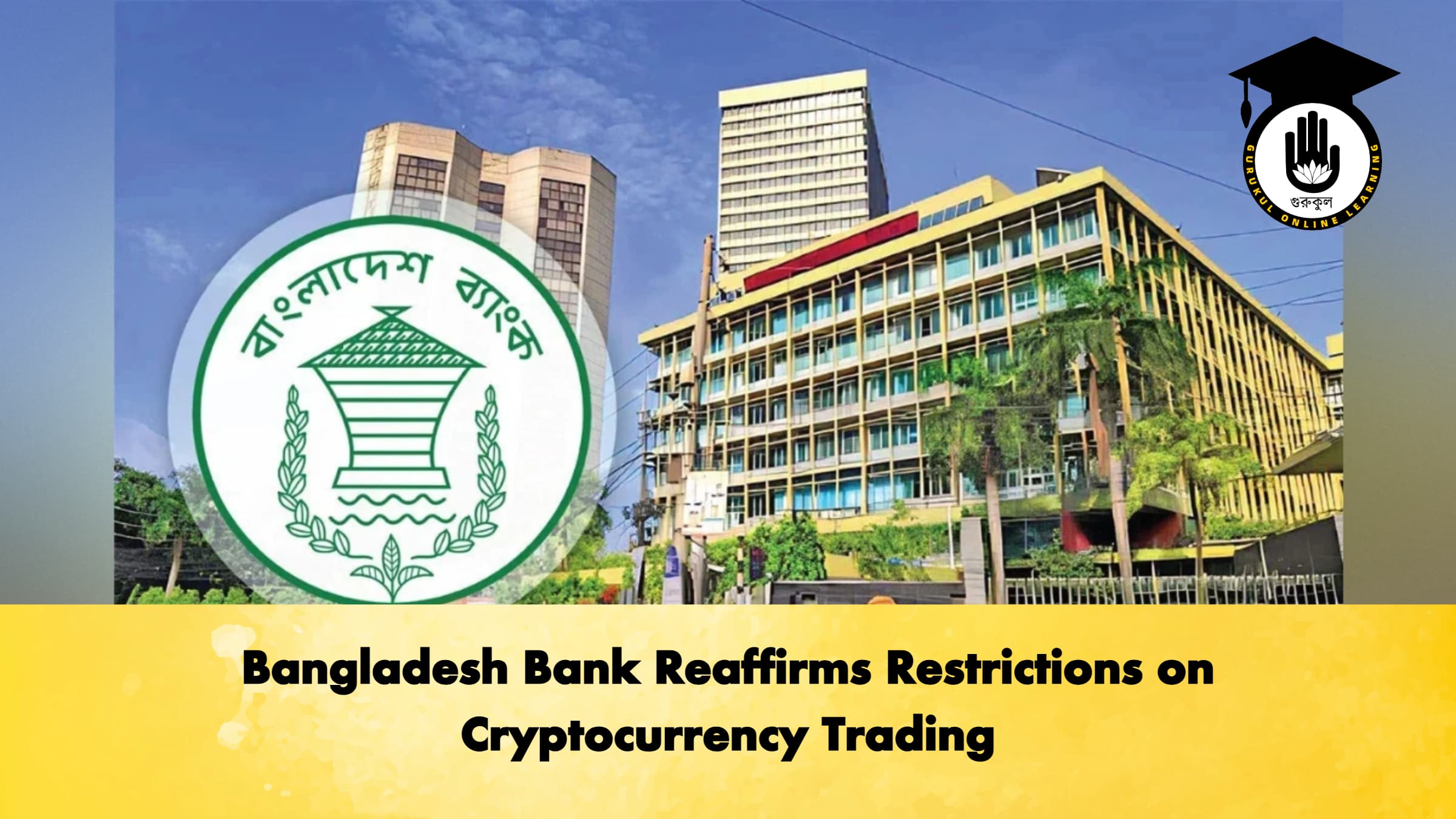
Under the latest directive, banks and financial institutions have been instructed to exercise caution and strengthen monitoring of customers’ accounts to prevent cryptocurrency-related transactions through the formal banking system. The instructions will remain effective for one year from the date of issuance of the circular.
Bangladesh Bank issued the circular on Thursday (29 October), reaffirming its longstanding position on virtual assets and their use in the country’s financial system.
The latest directive forms part of a consolidated policy framework covering foreign exchange management and banking operations. It includes provisions on foreign exchange rates and reporting requirements, transactions between authorised dealer (AD) banks and Bangladesh Bank, and payments and settlements under the Asian Clearing Union (ACU) arrangement.
The framework also covers foreign currency accounts, limits on banks’ foreign exchange open positions, reconciliation of Nostro accounts, forward transactions and swaps. Guidelines on hedging against fluctuations in commodity prices in import trade have also been incorporated.
Restrictions on the exchange, transfer and trading of virtual assets and virtual currencies have been explicitly included in the consolidated framework, reinforcing the central bank’s position on cryptocurrency-related activities.
Bangladesh Bank’s restrictions on virtual currencies date back to September 2022. On 15 September that year, its Foreign Exchange Policy Department issued a circular stating that transactions intended to acquire virtual assets or virtual currencies from Bangladesh, into Bangladesh or within the country were not permitted.
The central bank followed this with another instruction on 12 October 2022, directing banks to strengthen monitoring and take appropriate measures to prevent such transactions. Financial institutions were asked to remain alert to attempts to use banking channels for cryptocurrency-related activities.
The latest circular reiterates those earlier instructions and places the restrictions within a consolidated framework governing foreign exchange operations.
Explaining its regulatory position, Bangladesh Bank has stated that virtual currencies are not recognised as legal currency under the Foreign Exchange Regulation Act 1947. Unlike conventional national currencies, these digital assets are not backed or guaranteed by any sovereign state.
Their lack of official backing, combined with significant price volatility, exposes investors to considerable financial risks. Cryptocurrency prices can rise or fall sharply within short periods, making investments vulnerable to sudden market movements. The absence of conventional financial safeguards can also leave users exposed to losses arising from market fluctuations and transaction-related problems.
Despite the restrictions, interest in cryptocurrency appears to be growing in Bangladesh, particularly through online platforms. Recent international research suggests that the country continues to feature in global cryptocurrency adoption trends, even though such transactions are not permitted under the central bank’s existing regulations.
According to the 2026 Geography of Cryptocurrency Report, published by international blockchain analytics firm Chainalysis, Bangladesh ranked 56th among 117 countries in grassroots cryptocurrency adoption this year.
The report analysed cryptocurrency usage patterns across the countries surveyed, providing an indication of how widely digital assets are being adopted at the grassroots level.
Among Bangladesh’s South Asian neighbours, India ranked sixth, Pakistan 25th and Sri Lanka 82nd. The rankings highlight differences in cryptocurrency adoption across the region.
Cryptocurrencies operate through digital networks, often using blockchain technology to record and verify transactions. Their decentralised structure allows users to transfer digital assets without relying on conventional banking intermediaries. However, this also creates regulatory challenges, particularly in monitoring cross-border financial movements, identifying transaction participants and preventing the use of digital assets for illicit financial activities.
For Bangladesh, the central bank’s continued restrictions reflect concerns over financial stability, foreign exchange management and the risks associated with unregulated digital assets.
The latest directive places renewed responsibility on banks and financial institutions to ensure that their services are not used to facilitate cryptocurrency transactions. At the same time, Bangladesh’s position in the Chainalysis rankings indicates that interest in digital currencies remains present despite the regulatory restrictions.
The developments underline the growing challenge facing financial regulators as digital assets become increasingly accessible through online platforms. Balancing technological developments with financial security, investor protection and compliance with existing regulations is likely to remain an important issue for Bangladesh’s financial sector.